2026-Export.png)
IBTTA’s Toll Excellence Awards recognize the very best projects and programs the international tolling industry has to offer. Each year, we celebrate IBTTA toll agency/operator and private sector members whose creative, innovative, and positive programs set a new standard of excellence. You must be an IBTTA member in good standing to be eligible for consideration. For questions about the Toll Excellence Awards Program, please contact Erin Mosher.
2026 Submissions will be accepted March 16 - July 2, 2026.
For categories and guidelines, review the Submit a Project Tab above.
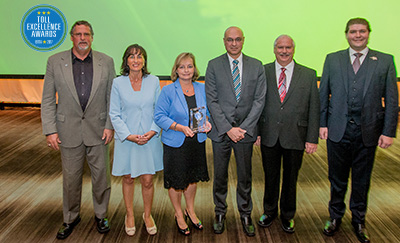
2025 Toll Excellence Awards Winners

Transitional Duty Program
Supporting Recovery, Sustaining Service: Illinois Tollway’s Transitional Duty Program
Launched in 2022, the Illinois Tollway’s Transitional Duty Program has become a model for workforce innovation, blending care for employees with operational strength. The program integrates 24/7 nurse triage, telehealth, real-time injury analytics, and tailored modified-duty assignments to keep staff engaged in meaningful roles during recovery. The results are tangible:
- 71% claims closure rate
- $351,000 in indemnity savings
- 54% reduction in total costs
- 56% fewer lost workdays in 2024
The Illinois Tollway is focused on supporting employees through recovery to ensure they stay connected to their teams and their purpose, while customers benefit from consistent roadway maintenance, reliable service, and safer operations. This proactive, data-driven, and people-first approach has made the Transitional Duty Program a cornerstone of the Tollway’s culture of care and accountability.

Raising Customer and Public Awareness about the Toll Text Scam
Guarding Against Smishing: Ohio Turnpike Protects Customers
In response to a nationwide “smishing” scheme impersonating toll agencies and attempting to collect fraudulent toll charges, the Ohio Turnpike and Infrastructure Commission (OTIC) launched a fast, coordinated multimedia campaign to protect customers and the public. Beginning in April 2024, the OTIC deployed Scam Alerts to more than 600,000 E-ZPass customers, issued four news releases, and leveraged social and traditional media to warn drivers how to spot and report fraudulent texts. A PSA video featuring a local media personality amplified the message, generating more than 323,000 paid views on Facebook, thousands of impressions on Turnpike TV at the Ohio Turnpike’s 14 service plazas, and wide national media coverage including CNBC. The campaign also included updates to the customer service call center IVR, which—together with the outreach—cut weekly call volume by 67% and reduced callback wait times from over an hour to just nine minutes.
By equipping customers with clear instructions, restoring confidence, and providing a model other agencies can replicate, the Ohio Turnpike’s campaign demonstrates how communications excellence safeguards both the public and the industry—earning the OTIC IBTTA’s 2025 Toll Excellence Award in Communications.

New York Central Business District Tolling Program and Congestion Relief Zone
Historic First: New York’s Congestion Relief Zone Reduces Gridlock and Advances Access
On January 5, 2025, New York City launched the first cordon-based congestion pricing system in the U.S., the Central Business District Tolling Program (CBDTP), creating the Congestion Relief Zone in Manhattan. Despite the highly complex policy and regulatory environment, this project demonstrates how tolling can deliver meaningful public benefits while balancing competing needs. The results have been immediate and measurable: traffic entering the zone has declined 12–13% year-over-year, speeds have improved, bus and paratransit trips are more reliable, crashes and noise complaints are down, and nearly $160 million was generated in the first quarter—on track to fund $15 billion in transit improvements across the region. The program also dedicates $248 million to mitigation efforts, including $100 million for Environmental Justice communities, and provides new discount and exemption plans for low-income drivers and people with disabilities.
Through unprecedented community engagement, careful design, and a seamless rollout, New York’s CBDTP sets a new global standard for social responsibility in tolling—earning MTA Bridges and Tunnels IBTTA’s 2025 Toll Excellence Award in Social Responsibility.

Drive Smart Florida: A Behavior Change Safety Campaign
The Central Florida Expressway Authority’s (CFX) Drive Smart Florida campaign is designed to combat the leading causes of preventable crashes on CFX expressways through a targeted behavior change marketing campaign (BCM). Designed utilizing the principles of BCM, which combines psychology with consumer insights to drive action, the goal of the campaign is to foster a culture of safety and courtesy and address the leading causes of crashes on its expressways including distracted driving, speeding, unsafe merging, work zone incidents, and road rage. Rather than relying on fear or guilt, the campaign emphasizes positive reinforcement and practical solutions, helping drivers see the immediate benefits of safe behaviors. CFX conducted in-depth research, segmented priority audiences, and rolled out targeted micro-campaigns such as “Smart Drivers. Safe Workers.” for work zones, “Merge Like a Master” to improve merging, the “Three-Second Rule” to reduce rear-end crashes, and “CARma Your Commute” to counter road rage. Since launching in 2023, the campaign has generated more than 12 million paid media impressions, 3 million earned media impressions, and 35,000 website visits, while building five new community partnerships.
By fostering empathy, engagement, and lasting behavior change, CFX’s Drive Smart Florida has set a new standard for safety communications—earning the agency IBTTA’s 2025 Toll Excellence Award in Safety.

Cashless Tolling Conversion
One Night, One System: Kansas Turnpike’s Seamless Cashless Conversion
On July 1, 2024, the Kansas Turnpike Authority (KTA) executed a full-system conversion to cashless tolling—one of the most significant technology undertakings in its 70-year history. In a single night, KTA replaced its trip-based ticket system with an advanced per-mile, all-electronic tolling platform, constructing 36 new toll zones with 72 gantries, installing equipment at 42 toll zones, and deploying next-generation roadside collection systems integrated with a new, state-of-the-art back office. At the heart of this modernization is the innovative “One Account” system, which unifies transponder and license plate transactions into a seamless customer experience while improving operational efficiency and revenue assurance. Since launch, KTA has distributed more than 343,000 transponders, achieved rising ETC adoption, and maintained strong collections. A smooth workforce transition and a communications campaign reaching more than 50 million people further supported customer acceptance.
By pairing bold technology deployment with thoughtful implementation, KTA has set a model for industry-wide modernization—earning IBTTA’s 2025 Toll Excellence Award in Technology.

Habitual Violator Enforcement Remedies Program
Protecting Revenue, Promoting Fairness: CTRMA’s Habitual Violator Program
The Central Texas Regional Mobility Authority (CTRMA) implemented its Habitual Violator (HV) Enforcement Remedies Program to ensure all road users contribute their fair share to the region’s transportation system. Supported by state legislation, the program employs a graduated approach—beginning with courtesy letters and escalating, when necessary, to registration renewal blocks, prohibition orders, and on-road enforcement. This structured, data-driven process has delivered measurable results: in 2023, 28.6% of habitual violators made payments, monthly revenues increased consistently, and the program achieved an extraordinary 2,171% return on investment. Behavioral shifts are equally significant, with a 55% reduction in repeat violations among those completing the full remedy process. By pairing enforcement with thoughtful customer communications, CTRMA has improved awareness of toll payment obligations and transformed initial opposition into public support. Through technology integration, strategic collaboration, and a fair, transparent process, CTRMA’s HV Program demonstrates operational excellence and sets a model for revenue protection and system integrity—earning IBTTA’s 2025 Toll Excellence Award in Toll Operations, Engineering & Maintenance.

MTA Bridges and Tunnels Central Business District Tolling Program
AI-Powered Tolling at Scale: TransCore Powers New York’s Congestion Relief Zone
In partnership with MTA Bridges and Tunnels, TransCore delivered the U.S.’s first congestion pricing system, launched on January 5, 2025, in Manhattan’s Central Business District. Designed for one of the world’s most complex urban environments, the compact all-overhead solution minimized disruption, preserved historic infrastructure, and blended seamlessly into the city streetscape. At its core, the system leverages a novel application of AI and machine vision to process every vehicle as a video-based transaction from all-overhead enclosures, ensuring accuracy and scalability across millions of daily entries. The results have been immediate: tens of thousands fewer daily vehicle entries, improved weekday rush-hour speeds, fewer collisions, drastic reduction in noise complaints, and hundreds of millions of dollars generated for needed transit improvements.
With features like variable pricing algorithms, AI-based video classification, and APIs for multimodal third-party integration, TransCore’s solution sets a global benchmark for congestion pricing innovation—earning IBTTA’s 2025 Toll Excellence Award in Private Sector Innovation.

The Use of Data and Data Analytics for Road Traffic Management
Faster Detection, Safer Roads: Valerann's AI-powered Platform Reduces Incident Detection Time and Improves Road Safety.
In collaboration with Transport Infrastructure Ireland (TII) and Roughan & O’Donovan, Valerann deployed its AI data fusion platform, Lanternn, to enhance real-time traffic management and incidence response on Irish motorways. Lanternn ingests and processes in real time large volumes of structured and unstructured data from multiple data sources - floating car data, roadside sensors, CCTV, navigation apps, weather reports and historical data to deliver an accurate and comprehensive traffic information on a single pane of glass.
Tested on the M1 and M6, the pilot demonstrated on average 25-35 min reduction in incidents detection time, including detection of a multi-vehicle crush within one minute by consolidating 134 individual alerts from 5 sources. The results: faster operator response, reduced congestion and secondary crashes, and higher detection rates, with 47% of M1 and 65% of M6 incidents flagged earlier. Lanternn also detected additional incidents; if scaled nationwide, this equates to up to 20 additional incidents daily.
Hardware-agnostic, cloud-native, and predictive by design, the project demonstrates how AI and the use of data analytics can revolutionize roadway safety and efficiency—earning Valerann IBTTA’s 2025 Toll Excellence Award in Private Sector Innovation.
2026 Submission period: March 16 - July 2, 2026
Be sure to download and reveiw the Guidelines document below. A submission link will be live on Monday, March 16.
Award Categories for Public Sector Members
Eligibility: Toll Agency/Operator/Non-North American Group Members
There are six award categories for Public Sector Members. Public Sector Winner(s) are eligible for the President's Award.
- Administration & Finance
- Customer Service & Marketing Outreach
- Safety
- Social Responsibility
- Technology
- Toll Operations, Engineering & Maintenance
- President's Award - given to the best sumbission overall in Public or Private sectors.
Award Category for Private Sector Members
Eligibility: Suppliers of products or Consulting Services to the industry.
There is one category for Private Sector Members.
- Private Sector Innovation Recognition Award
Up to three (3) organizations who submit a project or program that has in some way furthered the mission of IBTTA and the tolling industry may be given an award.
Past Toll Excellence Awards Winners
Big Lift Communications and Engagement Plan
Overview
Halifax Harbour Bridges is a provincial Crown corporation that manages and operates the Macdonald and MacKay Bridges in Halifax, Nova Scotia. The two tolled suspension bridges join Halifax and Dartmouth, with combined annual crossings of approximately 33 million. The Macdonald Bridge accounts for approximately 40 percent of the region’s daily commuter traffic, and its sidewalk and bike lane provide the only active transportation route across the Halifax Harbour. The Big Lift was HHB’s largest capital project since the MacKay Bridge opened in 1970, extending the life of the Macdonald Bridge by at least 75 years and reducing maintenance costs. Construction began in March 2015 and concludes in 2018.
The Macdonald Bridge was operating safely after 63 years in service, but the deck was wearing out. The Big Lift replaced the infrastructure on the suspended spans of the bridge including the road deck, floor beams, stiffening trusses and suspender ropes on the suspended spans of the Macdonald Bridge. The $205-million project budget was covered by a provincial government loan that will be repaid entirely with toll revenue. To manage a unique, tremendously complex, and disruptive project, HHB orchestrated the removal and replacement of 46 deck segments while keeping the bridge open to traffic most of the time. The work was completed with overnight and weekend bridge closures over a two-year period. It was only the second time in the world that suspended spans of a suspension bridge have been replaced while keeping the facility in operation. The HHB communications team of two developed a comprehensive strategy to educate and engage all stakeholders.
Objectives
To ensure Stakeholders are educated about the project and how it will impact them and for affected stakeholders to believe their perspective has been taken into consideration during the planning phase of the project. The public understands this project is necessary to extend the life of the Macdonald Bridge and for the long term safety of the travelling public.
Results
The Big Lift needed to be done to extend the life of the bridge, not to add capacity. This made communications more difficult because customers were not gaining anything other than a safer bridge. The communications motto of the project was to “show don’t tell” by sharing stories, videos and photos so people could understand the engineering wonder that this was and to communicate early and often the reality of the project: it would be disruptive but necessary to extend the life of the bridge. A final survey to see if the objectives were accomplished will be completed in the latter part of 2018. The overall sentiment from the community is that the project wasn’t as disruptive as initially anticipated and that itwas a fascinating project to watch unfold. This project provided an opportunity to accomplish an overall communications goal for HHB which is to be seen as the safe, efficient, forward-thinking manager of Halifax's key transportation infrastructure assets.
Toll Relief: Reinventing Equity in Mobility
Overview
Toll Relief, the first program of its kind in the United States, provides meaningful financial relief to qualified residents who travel the Elizabeth River Tunnels in Virginia eight times or more a month and have a personal, annual income of $30,000 or less. The relief is the equivalent to as much as a 57 percent reduction in tolls. Transportation equity for those most in need has always been a challenge. With the Commonwealth planning more tolling projects, the Virginia Department of Transportation (VDOT) committed to build public awareness of the role tolling plays in delivering funding for much-needed highway improvements, while simultaneously ensuring equity for individuals in lower socio-economic brackets. In addition to implementing an aggressive outreach program to educate the public around the need for and benefits of tolling projects, VDOT introduced Toll Relief to assist citizens facing the biggest financial impacts from tolls. In October 2016, Governor Terry McAuliffe announced that Norfolk and Portsmouth residents would receive help paying tolls on the Elizabeth River Tunnels through a new Toll Relief program. The operators of the Elizabeth River Tunnels are contributing $5.5 million over 10 years to help offset the cost of tolls on those individuals most financially stressed. The agreement is part of a broader deal to reduce the financial impact of major construction improvements for motorists in Hampton Roads.
Objectives
The program was designed to provide meaningful financial relief to the most economically challenged residents of the Portsmouth/Norfolk region (annual household income < $30K) that utilize the ERC more than 8 times per month. These tunnels are the only "timely" route between the two cities and had not previously been tolled. This program allowed working citizens from lower socioeconomic households to continue using their primary route to work with a reduction in the tolls therefore, reinventing equity in tolling and mobility for the Hampton Roads area.
Results
This program greatly reduced the concerns of stakeholders in the region regarding equity issues for financially distressed residents utilizing the newly tolled tunnels between Portsmouth and Norfolk. By implementing a local stakeholder steering committee and mounting an aggressive communications strategy, consensus was gained and support established for the buy-in of the Toll Relief program. Consequently, education around tolling increased and acceptance of tolling as a funding source grew in acceptance for the Hampton Roads area. By deploying a program which introduced "equity" into the tolling conversation, the roll out of subsequent tolled projects has met less resistance in this region. The most demonstrable result of the program was the number, over 2000, of participants/customers enrolled in the program.
In its first year in 2017, Toll Relief delivered $458,000 in financial relief to 2,094 residents. Enrollment for 2018 is over 3,000.
Customer Value and Interoperability through Tri-Protocol Reader Technology
Overview
In September of 2017, the North Carolina Turnpike Authority (NCTA) became the first agency in the nation to read all three transponder protocols being considered for national interoperability, in a tolling-environment. Specifically, the NCTA successfully replaced the legacy reader technology on 80 lanes of the Triangle Expressway with tri-protocol reader technology. The implementation of new reader equipment was completed under live traffic, without interruption to toll collection activities, and minimizing any impact to NC Quick Pass customers. In addition to directly supporting IBTTA and the Moving Ahead Progress in the 21st Century Act's (P.L. 112-141), (MAP-21) efforts for nationwide interoperability on electronic toll collections programs, the implementation allowed the NCTA to introduce free 6C transponders and reduced cost E-ZPass interoperable transponders to its customers.
Objectives
With two new toll projects scheduled to open within 18 months, the NCTA began investigating options to reach a new customer base by offering low cost transponder options and avoiding disruption to existing customers by preventing a transponder recall. The NCTA also wanted to prepare for the future of national interoperability by implementing cutting edge technology capable of reading all three candidate protocols, establishing the NCTA's path forward for technology to be utilized on all future toll facilities in North Carolina. In conjunction with the tri-protocol reader technology, the NCTA procured new, low cost 6C transponders that are offered to NC Quick Pass customers for free. The NCTA also procured lower cost TDM transponders, providing for the sale of these transponders at a lower price point. Considering the new transponders and the tri-protocol reader technology, the established objectives were mutually beneficial for the NCTA and its NC Quick Pass customers. The top priority was to offer free/lower cost transponders, which also saves customers 35% off tolls in North Carolina. Other goals included increasing transponder usage on the Triangle Expressway and converting government, fleet and first responder users to transponder accounts (previously registered license plate account customers).
Results
Since go-live in September 2017, the tri-protocol reader implementation and lower cost transponders have positively affected both the NCTA and its NC Quick Pass customers. The decrease in unit pricing for the three current transponder options averaged nearly 70%, and total savings passed along to NC Quick Pass customers have totaled nearly $600,000 over the past eight months. More specifically, the NCTA achieved a primary goal of offering a free transponder to customers. Between January 2012 and August of 2017, the NCTA sold approximately 4,400 NC Quick Pass transponders per month. For the eight months since offering lower cost transponders, the NCTA has sold approximately 8,900 transponders per month, more than doubling the previous average. In addition, the NCTA has verified a notable rise in transponder-based transactions on weekdays before and after the implementation (59% and 63% respectively), thus reducing the costs associated the postpaid (license-plate based) billing program. Further, for the first time in NCTA's history, overall transponder-based transactions exceeded 60% for an entire quarter (January - March 2018).
The NCTA continues to put customers first and worked diligently to utilize state-of-the-art technology in the tolling industry. By procuring new transponder offerings and tri-protocol reader technology, the NCTA was able to immediately pass on the cost savings to its customers and has identified and incorporated operational efficiencies accordingly. In addition, all toll roads in North Carolina will be equipped to read the three transponder protocols being considered for national interoperability. In addition, the NCTA has demonstrated that tri-protocol technology can work in a tolling environment, with accurate transponder reads at high speeds, and without impacting the customer experience, revenue, or interoperable partnerships. By taking the risk of being the first agency to install this technology, the NCTA has helped reduce the risk to fellow agencies considering similar implementations.
The NCTA has been at the leading edge of implementing new toll collection technologies and is the first agency in the United States to read the three transponder protocols in a tolling environment being considered for national interoperability.
Supplemental Lane Analysis and Monitoring (SLAM)
Overview
One of the primary risks of converting to an All Electronic Tolling (AET) system is the loss of revenue. If the technology system that supports the toll collection system in any way fails to perform at peak levels, it may prevent a toll agency from collecting all revenues due from its customers. In other words, problems on the front end of the system can cause collection problems in the back office. The objective of Florida's Turnpike is to reduce, to the maximum extent possible, any uncollected revenue. In November, 2005, Florida's Turnpike opened the SunWatch Operations Center. In fact, the SunWatch Operations Center won the IBTTA Toll Excellence Award in the Operations Category in 2008. SunWatch was a first in the toll industry, providing 24/7 monitoring of the toll collection system with the ability to detect and diagnose problems remotely, often making repairs from the SunWatch Center. While SunWatch is still operating today and continues to have enhancements for real-time monitoring and response, the SLAM Program takes the next step in revenue assurance by examining the lane and back office systems to detect degraded modes of operation. The analogy to SunWatch is going to the doctor as a result of an acute injury, like a broken leg - you detect the problem and resolve it; while the analogy to SLAM is going to get an in-depth annual blood analysis to detect any potentials problems and then taking corrective action, such as starting a vitamin regiment, to ensure your body is functioning optimally.
Objectives
The primary objective of the Turnpike's SLAM Program was to improve the Turnpike's revenue collection efficiency. The Turnpike has many established performance metrics which are monitored by a government oversight body, the Florida Transportation Commission. Revenue performance is a major factor in the evaluation for the Commission and to Bond Rating Agencies. Although several individuals at the Turnpike were engaged in analyzing system performance, there was not a concerted or coordinated effort. The SLAM TEAM developed the program and implemented on a Turnpike-wide basis with a team of professionals from diverse backgrounds including finance, network communications, toll lane systems and computer network and hardware expertise.
Results
The results of the SLAM Program have been outstanding. The Turnpike estimates that the team efforts have resulted in over $10 million in collected revenues and operational cost savings per year over the past three years, for a total savings in excess of $30M. This has been accomplished through a combination of detecting degraded equipment; lane system improvements and implementing video toll processing improvements. The application of performance metrics in equipment and system performance in a coordinated and documented way is innovative and has improved the bottom-line for Florida's Turnpike.
SLAM's track record of precise findings, detailed reports, and successful recommendations for improvements has quickly gained respect within the agency and made them the "go-to" team for any problem requiring in-depth analysis. In the three years of operation, they have logged and closed over 250 investigative issues, including 12 complex issues that included system upgrades and gained the agency $14M in revenue through a combination of increased toll revenue and decreased operations costs.
New Mersey Gateway Bridge
Overview
The New Mersey Gateway Bridge is an innovative response to a seemingly impossible situation faced by many local transport authorities around the world. Congestion on the aging local bridge had reached dangerous levels, with traffic volumes that risked community access to essential services on either side of the River Mersey. With no government funding available, the community knew it would never have the funds to complete the project unassisted. The Silver Jubilee Bridge over the River Mersey, built in 1961, constitutes a vital link for the residents of the Halton borough. Fifty-five years later, the bridge was approaching 10 times its intended traffic capacity, with daily peaks of up to 85,000 users in late 2017. The community wanted a second bridge across the River Mersey. But funding from the national government was denied due to scarce public funding resources.
With the responsibility pushed back to the borough council, it fell to a community of 125,000, with an annual budget of just over $130 million, to fund a $800 billion infrastructure project. To get the mobility it needed, the community accepted tolling on the existing bridge as well as the new one, after traffic modeling indicated that revenue from the new structure alone would not cover capital and operating costs. Given a choice between tolling both bridges or having no new bridge at all, the borough council overwhelmingly supported the project, as did local businesses and most residents. Halton needed an experienced toll service provider that could capture and channel the community’s vision. emovis met that challenge with an innovative tolling solution that earned community support, while delivering the revenues the borough needed to meet its contractual obligations.
Objectives
The primary objective of the New Mersey Gateway was to relieve relentless congestion on a local network where simply expanding the existing bridge would not have been sufficient. The new kilometre-long, cable-stayed bridge has three lanes in each direction, with a toll-free bypass for local traffic in Runcorn town center. The key operating principles for the project included:
Accountability
A 100% in-house customer care service, including telephone and walk-in centers, allows the operator to constantly improve customer satisfaction while adjusting to rapidly changing consumer behaviors, particularly on the part of the Millennial generation.
Trust and Transparency
An innovative, thermal-based traffic auditing system provides local authorities with independent confirmation that all toll revenue is duly collected and properly transferred to them.
Freedom
A flexible tolling solution offers users a menu of options, including RFID sticker tags, a pay-by-plate option, and microwave tags.
The bridge opened on October 14, 2017 and quickly became a preferred route for more than 70,000 users per day. The project also funded the refurbishment of the original Silver Jubilee Bridge, while keeping that historic structure in public hands. The refurbishment included conversion of one lane into a toll-free pedestrian and bicycle route that offers residents a safer, more sustainable option for crossing the river.The system is efficient enough that local residents can buy unlimited access to both bridges for a modest annual fee, with free access for users with disabilities.
Results
The project delivers stable, long-term toll revenue of about $70 million annually that has enabled a small borough council to reduce traffic congestion and plan for future population growth. Users save as much as an hour or more on their regular commutes.
Public acceptance of the project was overwhelming, with more than 85% of potential local users pre-registered by the time the new bridge opened.
- The toll operator emphasizes excellence and continuous improvement in customer service, with 230 verification and administrative staff in its call center and walk-in facilities available to local users.
- Prior to launch, the project team established MerseyFlow as a strong, widely-recognized brand that supported an aggressive and successful pre-marketing strategy.
- A competitive public-private partnership (PPP) tendering process produced a £250-million cost saving compared to the original engineering estimate.
- Construction emphasized local hiring, with more than 5,000 employees devoting five million person-hours to engineering and construction.
80/90 PUSH Project
Example Text in the H3 formatting
The ITR Concession Company (ITRCC) receives the Administration and Finance Award for its innovative methods of procuring and contracting the 80/90 PUSH project along the Indiana Toll Road. The Indiana Toll Road runs 157 miles east-west across the entire state of Indiana, from the Illinois to Ohio state lines. 80/90 PUSH is massive in scope and includes upgrading 292 lane miles (73 linear miles), 9 interchanges, and 53 bridges, and installing a fiber optic backbone along the corridor as a step to implementing an Intelligent Transportation System. With a $220 million budget it is the largest investment in the Indiana Toll Road since its initial construction in 1956.
80/90 PUSH incorporated an aggressive procurement and delivery schedule to deliver the project swiftly and with minimal travel disruptions. To meet deadlines and minimize costs ITRCC utilized an innovative blend of Early Contractor Involvement (ECI) and Design-Build project delivery strategies. ITRCC involved contractors early in the project, ran concurrent design processes, and remained committed to transparency and communication with prospective partners. ECI is typically performed with one contracted design team, but by offering $250,000 to the unsuccessful team ITRCC kept multiple parties involved and maintained competitive pricing tension.
Considering the scope of investment in 80/90 PUSH, ITRCC maintained a strong contractual position throughout the project and implemented specific penalties for delays, traffic queues, and cost overruns. ITRCC mitigated future risks by negotiating an extended 7-year warranty thus assuring a well maintained, high quality product. Today 80/90 PUSH is ahead of schedule and under budget. Over 100,000 working hours have been logged without a single lost time injury. The safety, speed, and cost effectiveness of the project reflects the exemplary partnering and procurement strategies demonstrated by ITRCC.
Commuter Credits
 In 2014, the state of Georgia integrated the State Road and Tollway Authority (SRTA) and the George Regional Transportation Authority (GRTA) as a means to meet evolving demands for mobility through shared infrastructure, operations, and costs. SRTA receives the Customer Service & Marketing Outreach Award fo the Commuter Credits Program, an innovative initiative from the newly integrated agency. Commuter Credits are intended to help commuters think about their transportation in a more integrated way, reduce congestion along the heavily traveled I-85, and reduce SOV usage of Georgia’s Express Lanes during peak hours. The pilot program included three components:
Shift Commute – 243 existing Peach Pass users were offered weekly $3 toll credits for reducing their weekly peak period commutes from 4+ trips to 3 or fewer; Start a Carpool – SRTA attracted carpools to the express lanes by offering daily $3 toll credits to carpools with at least one Peach Pass user; Ride Transit – SRTA offered Peach Pass users daily $2 toll credits for taking the GRTA Xpress bus routes during peak periods.
Over the course of the pilot program 210 commuters took 4,500 trips using Ride Transit. Through Shift Commute, drivers moved almost 500 trips to off-peak periods or to another mode of transit. A vast majority of users said they found both programs easy to understand and would likely continue to use them in the future. SRTA plans to continue Ride Transit and Shift Commute on a permanent basis beginning in 2018.
Commuter Credits’ positive effects and tremendous user feedback demonstrate SRTA’s exemplary commitment to community outreach and engagement. The Community Credits Program has garnered global recognition for successfully highlighting the first steps agencies can take to serve users’ increasing demands for efficiency through a unified transportation system.